
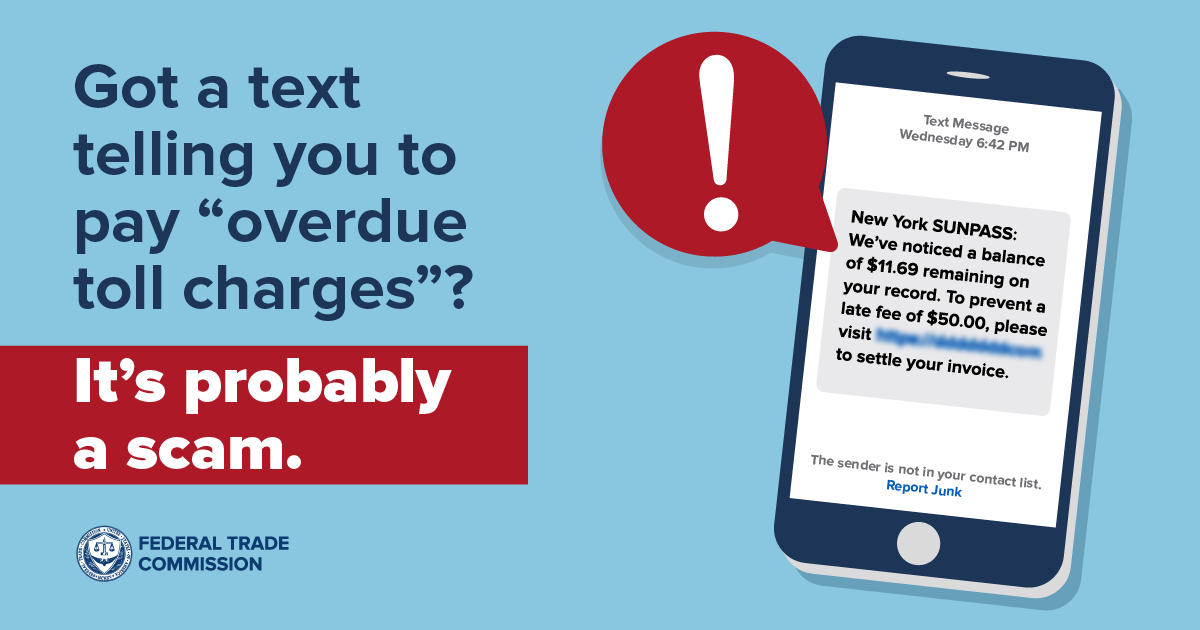
That text about overdue toll charges is probably a scam

When you go through a toll, you know you’ll need to pay a fee to use that road or bridge. But scammers are targeting drivers with text messages pretending to be from the tolling agency collecting “overdue toll charges.” Here’s what to know about this text scam.

The scammy text tells you to click a link to pay “overdue toll charges” to avoid late fees. But it’s probably not the tolling agency contacting you. It’s probably a scammer. Clicking the link can lead to a phishing attack, where the scammer tries to take your personal information (like your driver’s license number) — and even steal your identity. And if you pay, not only are you out the money, but the scammer gets your credit card number, too.

To spot and avoid text scams about a fake toll:

  • Slow down. Don’t rush to click on links or respond to the text. Scammers want you to react quickly when they send you an unexpected text message, but it’s best to stop and check it out.
  • Check with the tolling agency. If you’re worried the text is legit, check with the state’s tolling agency. But use a phone number or website you know is real — not the info from the text.
  • Report unwanted text messages. Use your phone’s “report junk” option to report these unwanted texts to your messaging app or forward them to 7726 (SPAM).
  • Don’t engage. Delete the message. Unwanted messages often lead to scams. Once you’ve checked it out and reported it, delete the text message. And don’t engage.

Share this information with people you know so they also can be prepared to spot and avoid the scam. And if you spot a text scam, the FTC wants to hear about it. Go to ReportFraud.ftc.gov and tell us your story.
Image

Popular posts from this blog

More Than $5 Million in Refunds to Consumers Harmed by Bogus Credit Repair Scheme

  The Federal Trade Commission is sending more than $5 million in refunds to consumers harmed by a deceptive credit card debt relief scheme known as ACRO Services. The FTC filed a lawsuit  in November 2022  against ACRO Services, which operated under multiple names such as American Consumer Rights Organization, Consumer Protection Resources, Reliance Solutions, Thacker & Associates, and Tri Star Consumer Group. The complaint charged the company and its owners with running a deceptive telemarketing operation that made numerous phony debt relief promises to consumers, including that they could greatly reduce or eliminate consumers’ credit card debt in 12 to 18 months. They charged consumers thousands of dollars in unlawful upfront enrollment fees and told them it was part of the debt that will be eliminated as part of the program. Consumers were also charged monthly fees ranging from $20-$35 for “credit monitoring” services. The individual defendants agreed to a se...

Williams-Sonoma Will Pay Record $3.17 Million Civil Penalty for Deceptive use of Made in the USA

  Home products company Williams-Sonoma will be required to pay a record civil penalty of $3.175 million for violating a 2020 Federal Trade Commission order requiring the retailer to tell the truth about whether the products it sells are Made in USA. In a  complaint   filed by the Department of Justice upon notification and referral from the FTC, the agency charges that Williams-Sonoma listed multiple products for sale as being “Made in USA” when in fact they were made in China and other countries. The company  has agreed to a settlement   that requires them to pay the civil penalty, which is the largest ever in a Made in USA case. “Williams-Sonoma claimed its products were made in the United States even though they were made in China,” said FTC Chair Lina M. Khan. “Williams-Sonoma’s deception misled consumers and harmed honest American businesses. Today’s record-setting civil penalty makes clear that firms committing Made-in-USA fraud will not get a free pass.”...

Adobe used hidden fee to trap people into paying for subscription plans

Maybe you want to try out a product for a little while before you make a long-term decision. So, you sign up for a monthly subscription plan. Everything is fine until you want to cancel and it turns out to be a yearly subscription with monthly payments. Surprise! That’s what the FTC says happened to people who signed up for monthly subscriptions with Adobe. When people signed up on Adobe’s website for access to its software, the FTC says Adobe pre-selected the option for its “annual paid monthly” plan that put subscribers on the hook for a whole year of payments, paid in monthly increments — a fact that Adobe failed to explain or properly disclose. The lawsuit says Adobe used similar tactics when people signed up for a free trial and didn’t cancel before the trial ended. Adobe automatically placed them on the “annual paid monthly” plan without making it clear they were entering a one-year contract. When people tried to cancel before the year was up, they had to pay a hefty early te...